
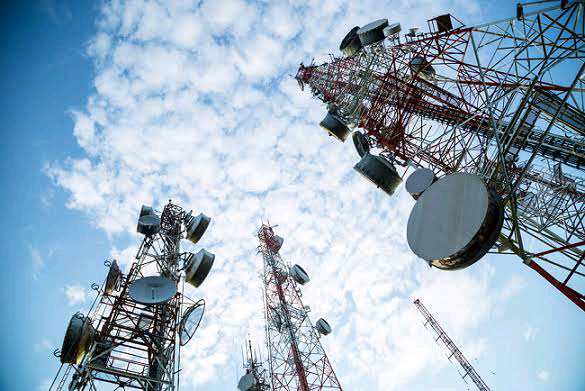
The Federal Government has been urged to harmonise right-of-way (RoW) charges across Nigeria and incentivise local production of telecom equipment as part of sweeping reforms needed to expand broadband access and secure the country’s digital future.
Telecom analyst Osita Odafi issued the call while warning that despite impressive gains in mobile and internet penetration, Nigeria’s telecom infrastructure is struggling to meet growing demands — particularly as the country prepares to roll out 5G, smart cities, and AI-driven services.
“Nigeria’s digital future rests on the strength of its networks, but the current system is weighed down by inconsistent RoW charges, power instability, forex volatility, and an overdependence on imported equipment,” Odafi stated.
Although the Nigerian Communications Commission (NCC) recommends a uniform RoW rate of N145 per meter, many state governments continue to demand fees as high as N10,000 per meter.
Odafi revealed that only 12 states have either waived the charges or adopted the NCC rate, while others continue to impose excessive and arbitrary fees — often disguised as environmental or processing costs — thereby stalling fibre deployment crucial for broadband expansion.
He noted that forex challenges and reliance on imported network equipment have escalated deployment costs, calling on the Central Bank of Nigeria to support the telecom industry through foreign exchange access, tax incentives, and financing schemes to encourage local manufacturing.
“CBN Governor Olayemi Cardoso’s recent push for local production is commendable, but it must be accompanied by regulatory clarity and financial support,” Odafi said, stressing that a long-term solution must include backward integration.
Highlighting power costs as another burden, he said the sector consumes over 40 million litres of diesel monthly.
However, he welcomed recent initiatives by the NCC and the Rural Electrification Agency to support the adoption of solar energy at telecom sites, calling it a vital step toward reducing operational costs and enhancing sustainability.
Odafi expressed concern that Nigeria’s 70 per cent broadband penetration target by 2025 may not be met unless urgent steps are taken.
He stressed the centrality of telecoms to critical sectors such as finance, education, and healthcare, warning that the country risks lagging behind in the global digital economy.
He also called for the protection of fibre infrastructure, citing over 50,000 fibre cuts in 2024 alone — 60 per cent of which were linked to government road construction activities.
He urged full implementation of President Bola Tinubu’s designation of telecoms as Critical National Information Infrastructure (CNII), which would ensure asset protection through stronger enforcement and community engagement.
Odafi concluded by stressing the urgency of implementing the national plan to deploy 90,000 kilometres of fibre optic cables and 7,000 rural base stations. “Time is running out. If we want to compete globally, infrastructure must come first,” he said.
