
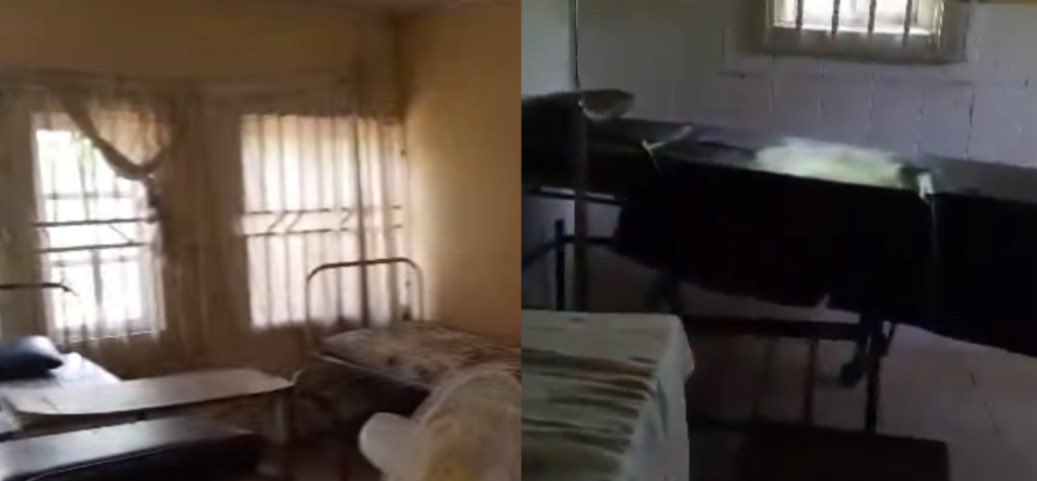
In the heart of Edo State, Nigeria, a government hospital meant to serve as a lifeline for 15 surrounding communities has become a symbol of neglect, forcing pregnant women to deliver their babies under dire conditions.
The facility, plagued by a lack of doctors, basic amenities, and reliable electricity, has left expectant mothers and their newborns at the mercy of an underfunded and overstretched healthcare system.
The hospital, located in a rural part of Edo State, is the primary healthcare provider for an estimated population of over 50,000 people across the 15 communities.
Yet, it operates with no resident doctor, a skeleton staff of nurses, and a critical shortage of essential medical equipment.
Frequent power outages mean that deliveries often take place in near-total darkness, with nurses relying on phone flashlights or candles to assist women in labor.
The absence of running water and sanitation facilities further compounds the risks, turning childbirth—a moment of joy—into a dangerous ordeal.
“It was terrifying,” said Blessing Osagie, a 28-year-old mother who recently gave birth at the hospital.
“There was no light, no doctor, and the nurses were doing their best with what they had.
I was praying for my baby to survive.” Osagie’s story is not unique. Women across these communities recount similar experiences, with many forced to travel long distances to seek care elsewhere, often on foot or by motorcycle, due to the hospital’s inadequacies.
Local leaders and residents have voiced their frustration over the state of the facility. “This hospital is all we have, but it’s like a death trap,” said Chief Emmanuel Omoregie, a community elder.
“We’ve been begging the government for years to send doctors and fix the place, but nothing changes.”
Reports indicate that the hospital has not had a permanent doctor in over three years, with visiting medical personnel appearing only sporadically.
The lack of funding has also led to shortages of basic supplies like gloves, syringes, and antiseptics, further endangering lives.
The situation reflects a broader crisis in Nigeria’s rural healthcare system. According to a 2023 World Health Organization report, sub-Saharan Africa accounts for 70% of global maternal deaths, with Nigeria having one of the highest maternal mortality rates in the region at 346 deaths per 100,000 live births.
Rural hospitals, like the one in Edo, are often understaffed and under-equipped, exacerbating the risks for pregnant women and their babies.
The WHO has warned that funding cuts to health services are rolling back progress in maternal care, particularly in fragile settings.
The Edo State government has acknowledged the challenges but cited budget constraints and logistical issues as barriers to immediate action.
A spokesperson for the state’s Ministry of Health, who spoke on condition of anonymity, stated, “We are aware of the situation and are working to deploy medical personnel and improve infrastructure.
But these things take time and resources.” Critics, however, argue that the government’s response has been slow and inadequate, leaving rural communities to fend for themselves.
Healthcare workers at the hospital, speaking anonymously due to fear of reprisal, described being overwhelmed. “We’re doing our best, but we can’t perform miracles,” one nurse said.
“Without electricity, water, or enough hands, every delivery is a gamble.” The nurse added that the lack of basic amenities forces them to make impossible choices, such as prioritizing patients based on limited resources.
The crisis has sparked outrage among advocacy groups, who are calling for urgent intervention. “No woman should have to give birth in darkness in a government hospital,” said Funmi Adeyemi, a representative of the Women’s Health Initiative, a local NGO.
“This is a failure of governance and a violation of basic human rights. The government must prioritize healthcare funding and ensure these facilities are equipped to save lives.”
Residents are now appealing to both state and federal authorities for immediate action, including the deployment of doctors, installation of solar power systems to address electricity shortages, and provision of essential medical supplies.
Some have also called for partnerships with international aid organizations to bridge the gap while long-term solutions are developed.
As the plight of these communities gains attention,NICU) equipment to ensure the survival of preterm or critically ill infants.
The absence of such facilities means that newborns with complications often do not survive the first few days.
Community leaders have also pointed to systemic issues, including alleged mismanagement of funds allocated for healthcare in the state.
“We hear about budgets for hospitals, but we don’t see the results,” said Patience Eguabor, a local women’s group leader.
“Where is the money going? Our women and babies are dying, and no one seems to care.”
The situation in Edo mirrors challenges across Nigeria, where rural healthcare facilities often struggle with similar issues.
A 2025 UNICEF report noted that maternal mortality in Nigeria remains a critical concern, with significant disparities between urban and rural areas.
The report emphasizes the need for increased investment in midwives, nurses, and community health workers to meet the UN’s Sustainable Development Goal of reducing maternal deaths to 70 per 100,000 live births by 2030—a target Nigeria is currently far from achieving.
As the sun sets over the 15 communities served by this hospital, the lack of electricity casts a literal and figurative darkness over the hopes of expectant mothers.
Without swift action, the cycle of preventable deaths and suffering will continue, leaving families to bear the cost of a broken system.
