
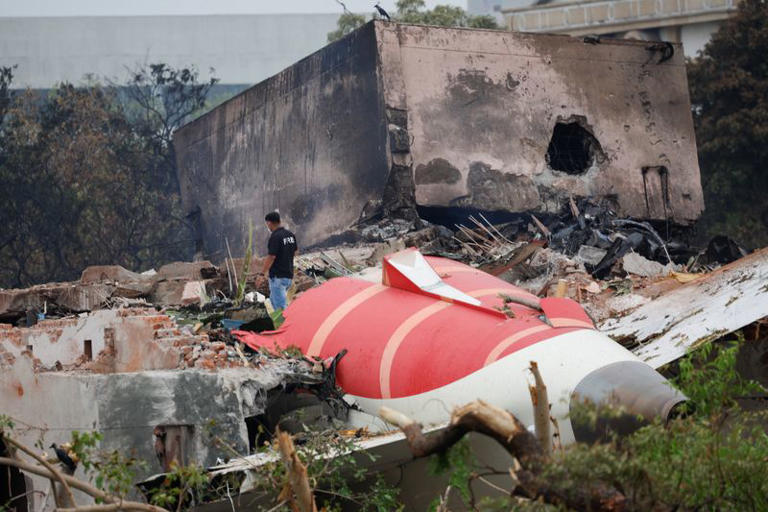
AHMEDABAD, India – The investigation into the catastrophic crash of Air India Flight AI171, a Boeing 787-8 Dreamliner that killed over 240 people, is zeroing in on potential issues with the aircraft’s engines, wing flaps, and landing gear, according to sources close to the probe.
The disaster, which occurred on June 12, 2025, shortly after takeoff from Sardar Vallabhbhai Patel International Airport in Ahmedabad, has prompted India’s aviation regulator to mandate immediate safety inspections across Air India’s entire Boeing 787 fleet, raising concerns about the airline’s maintenance practices and the aircraft’s configuration during the ill-fated flight.
The Boeing 787-8, carrying 242 passengers and crew bound for London Gatwick, crashed into a residential area in Ahmedabad’s Meghani Nagar neighborhood just moments after takeoff, erupting into a fireball that claimed the lives of nearly all onboard and at least 24 people on the ground.
Only one passenger, a British national, survived the crash, which marked the first fatal accident involving a Boeing 787 Dreamliner since the model entered service in 2011.
Preliminary analysis of CCTV footage and flight data suggests the aircraft struggled to gain altitude, reaching a maximum height of just 625 feet before descending rapidly.
Experts have pointed to several anomalies: the landing gear remained extended, and the wing flaps appeared to be retracted, an unusual configuration for takeoff that would have severely impacted the plane’s ability to generate lift.
“The fact that the aircraft still appears to be with its gear down and flaps retracted at 600 feet after takeoff is not the usual configuration,” said Professor Ron Bartsch, an aviation expert, noting that high temperatures of nearly 40°C in Ahmedabad would have required higher flap settings and greater engine thrust.
A source with direct knowledge of the investigation told Reuters that the probe is focusing on engine thrust, flap deployment, and why the landing gear remained down.
The pilots reportedly issued a mayday call seconds after takeoff, with some unconfirmed reports suggesting they mentioned “no thrust” or “engine failure.”
The deployment of the aircraft’s Ram Air Turbine, an emergency system that generates power in case of electrical or hydraulic failure, was also noted in some analyses, hinting at a possible cascading technical failure.
India’s Directorate General of Civil Aviation (DGCA) has responded swiftly, ordering enhanced safety checks on Air India’s 34 Boeing 787-8 and 787-9 aircraft equipped with GE Aerospace GEnx engines, effective from June 15, 2025.
These checks include one-time inspections of takeoff parameters, flight control systems, hydraulic systems, fuel monitoring, and cabin air compressors.
The DGCA is also considering whether to ground the entire 787 fleet pending the investigation’s outcome, though no such order has been issued yet.
Aviation experts have floated multiple theories about the crash’s cause. Some, including former British Airways pilot Alastair Rosenschein, suggest the flaps may not have been extended, a critical error that would prevent the aircraft from maintaining lift, especially under the heavy load of a long-haul flight.
“It does look like it’s an aerodynamic issue because of not having the right flaps setting on takeoff,” Rosenschein told Sky News.
Others, like former pilot Gaurav Taneja, speculate that a dual engine failure, possibly due to bird strikes, could explain the rapid descent, though the investigation source downplayed bird strikes as a primary focus.
The Boeing 787-8 involved, registered as VT-ANB, was delivered to Air India in 2014 and had logged over 39,000 flight hours. It had recently undergone maintenance and cabin upgrades as part of Air India’s $400 million fleet refurbishment plan.
While the 787 has a strong safety record, past issues with lithium-ion battery fires and recent whistleblower allegations about manufacturing defects have renewed scrutiny on Boeing, though experts caution that maintenance or operational errors may be more likely culprits given the aircraft’s age and service history.
The investigation, led by India’s Aircraft Accident Investigation Bureau (AAIB) with support from the U.S. National Transportation Safety Board, the UK Air Accident Investigation Branch, Boeing, and GE Aerospace, is prioritizing the recovery of the aircraft’s black box data recorders.
One black box has been recovered, and its data could provide critical insights into the flight’s final moments. “The black box will have all the flight data to confirm what happened,” said Dr. Jason Knight, a fluid mechanics expert at the University of Portsmouth.
The crash has sent shockwaves through the aviation industry and the city of Ahmedabad, where rescuers continue to search for victims amid the charred wreckage.
The tragedy has also reignited debates about aviation safety in India, with Ahmedabad airport known for frequent bird strikes, though this is not currently a key focus of the probe.
Air India, recently privatized under the Tata Group, has activated an emergency center to support affected families, while Boeing has pledged full cooperation with the investigation.
As the probe unfolds, questions remain about whether the crash was a one-off incident or indicative of broader issues with Air India’s maintenance or the Boeing 787 fleet.
A final report may take months or even years, but the DGCA’s proactive safety measures signal a commitment to preventing future tragedies. For now, the focus remains on uncovering the truth behind one of the worst aviation disasters in a decade.
Source: Reuters,
