
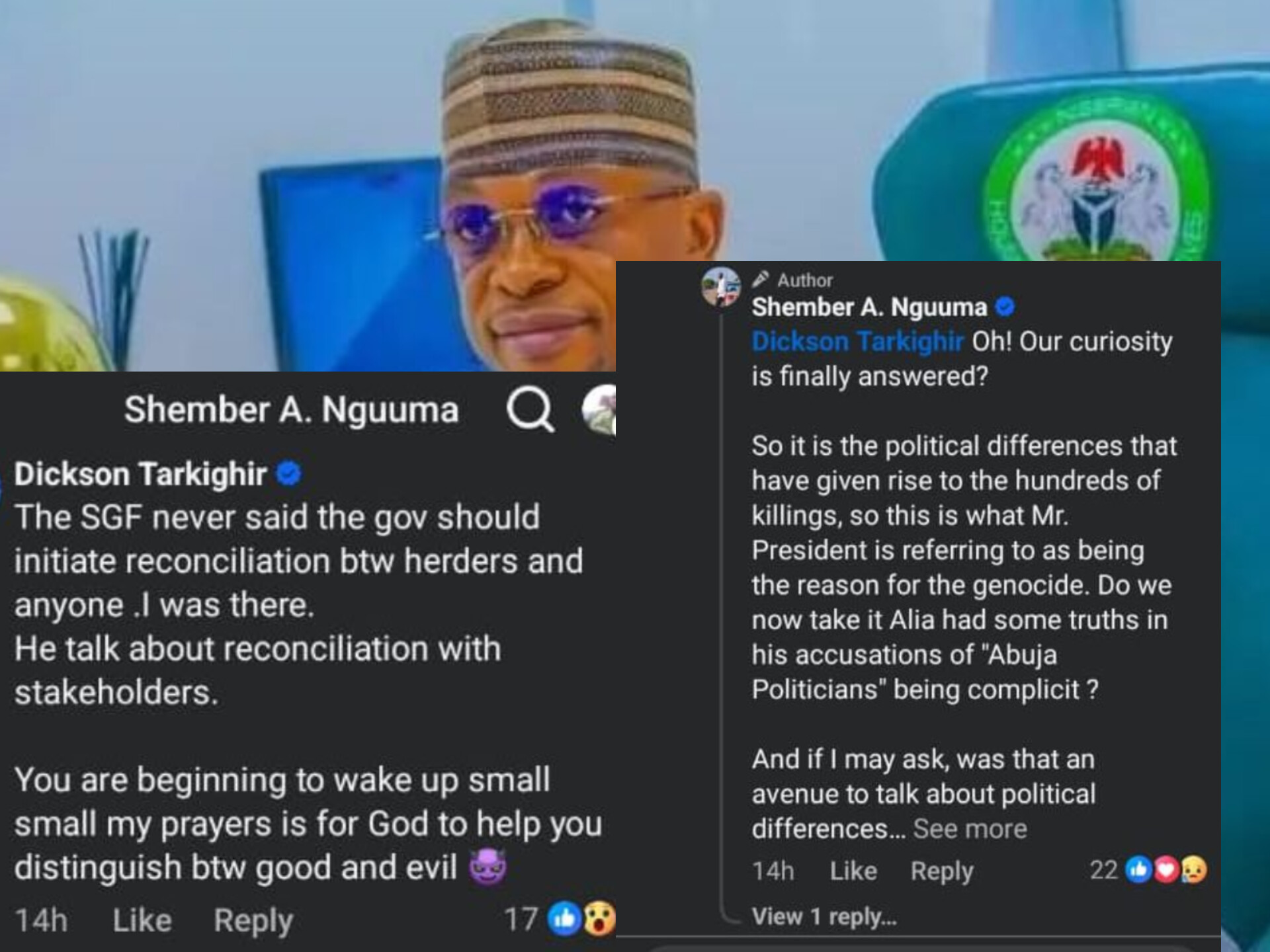
Makurdi – A disturbing narrative appears to be emerging from within Benue State’s political landscape, where certain members of the National Assembly have suggested that the rising insecurity in the state may not abate unless Governor Hyacinth Alia reconciles with their group, widely known as the “Abuja Stakeholders Camp.”
In a comment that has drawn widespread condemnation and concern, the member representing Makurdi/Guma Federal Constituency, Rt. Hon. Dickson Tarkighir has stated that peace in the state is contingent on political accommodation.
Reacting to discussions surrounding President Bola Ahmed Tinubu’s recent visit and the role of reconciliation in addressing the crisis, the lawmaker said, “The SGF never said the governor should initiate reconciliation between herders and anyone. I was there.
He talked about reconciliation with stakeholders. You are beginning to wake up small small. My prayer is for God to help you distinguish between good and evil.”
This remark, coming at a time when communities across Guma, Logo, Kwande, and other local governments continue to bury their dead and mourn their displaced, is now being interpreted as a dangerous attempt to blackmail the state government into political submission.
It echoes a growing pattern of political agitation from a faction of Benue politicians operating from Abuja who have long felt sidelined by the Alia-led administration’s refusal to cede governance to old power blocs.
Governor Alia, in recent interviews, has expressed deep frustration over what he described as a deliberate sabotage of his administration.
He openly accused some politicians based in Abuja of sponsoring violence in the state as a means of undermining his government.
While he stopped short of naming names, the timing of these remarks and the subsequent statements from federal lawmakers like Tarkighir and Ugbor have left little doubt in the minds of many observers that a coordinated campaign is in play.
Adding to the suspicion is the deafening silence of prominent figures from the so-called stakeholders’ camp, particularly the Minister of Water Resources and Sanitation, Prof. Terlumun Utsev, a son of Benue and one of the highest ranking federal appointees from the state.
Since the resurgence of violence in areas like Yelewata, Mbaikyor, Udei, and parts of Kwande, the Minister has neither visited the affected communities nor issued any public statement of condolence or solidarity.
As hundreds are displaced and countless families grieve, Utsev’s silence has been taken by many as evidence of a disturbing indifference—one that reinforces allegations that certain powerful individuals are more invested in securing political relevance than in restoring peace to their homeland.
The minister’s aloofness is particularly jarring considering his prominent position and proximity to the federal government’s machinery.
His silence contrasts sharply with the swift interventions and solidarity shown by leaders from other crisis-ridden states.
For many Benue indigenes, the failure of such a prominent figure to show concern during one of the state’s darkest periods is not just a matter of poor judgment, it is an indictment on the moral fabric of a political class that appears increasingly disconnected from the suffering of its people.
What is now unfolding in Benue is a tragic paradox: while the governor rallies federal support and navigates the complex task of rebuilding the state, some of his own supposed kinsmen and party men are reportedly using violence as a bargaining chip.
The narrative being peddled that peace will return only when they are “reconciled with” has all the markings of political hostage-taking.
For a state that has known too much bloodshed, and for a people who have long yearned for genuine leadership, such power games not only mock the pain of victims but embolden those who see chaos as an avenue to regain influence.
If peace in Benue must be purchased through political appeasement, then it raises a deeper, more haunting question— who truly benefits from the blood of the innocent?
As events continue to unfold, the people of Benue and indeed all Nigerians must reflect on what is at stake when ambition is placed above humanity, and when reconciliation is demanded not as a means to heal wounds, but as a tool to reclaim lost power.
