
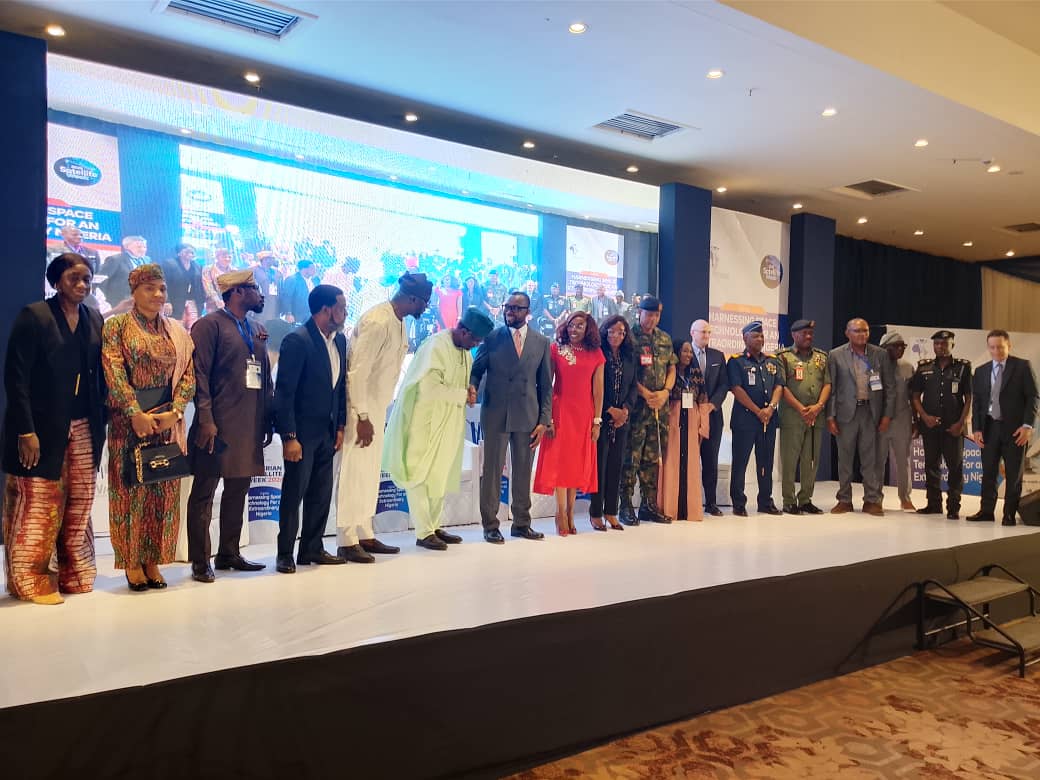
The Managing Director of Nigerian Communications Satellite Limited (NIGCOMSAT) , Mrs. Jane Nkechi Egerton-Idehen, officially opened the Second Nigerian Satellite Week, calling for renewed commitment to leveraging space technology for national development.
Addressing a gathering of government officials, military representatives, industry stakeholders, and technology innovators, Egerton-Idehen described the event as a critical platform for advancing Nigeria’s ambitions in the global space economy.
“This gathering is more than a convening of industry leaders; it is a reaffirmation of Nigeria’s commitment to harnessing the power of space for national development,” she said.
The two-day event, themed “Harnessing Space for an Extraordinary Nigeria,” focuses on strengthening the country’s role in a rapidly evolving global space sector. According to the NIGCOMSAT boss, the theme reflects both a moment of reflection and a call to action for future growth.
Day one of the programme centers on “The Space Race: The Convergence of Technology, Government and Opportunities,” examining how Nigeria can accelerate its participation in the global space economy.
The second day shifts attention to “Building Nigeria’s Space Future Through Strategic Alliance,” emphasizing partnerships, policy frameworks, and institutional collaboration.
Egerton-Idehen noted that the event coincides with the 20th anniversary of NIGCOMSAT, describing the milestone as a testament to Nigeria’s long-standing commitment to space technology.
“Two decades ago, Nigeria made a sovereign decision to own its place in space,” she said, adding that the organization has since evolved into a multi-service provider delivering connectivity, broadcasting, and broadband services across Nigeria and Africa.
Highlighting recent developments, she pointed to the transformation of the global space economy driven by satellite broadband expansion and increased commercialization.
She emphasized that Nigeria has remained an active participant by investing in technical capacity and innovation.
She also showcased NIGCOMSAT’s efforts in capacity building, including VSAT training programmes conducted in Adamawa, Jigawa, Cross River, and Enugu States, aimed at equipping young Nigerians with skills in satellite technology.
In addition, the agency’s Accelerator Programme continues to support startups working in satellite applications and digital infrastructure. The launch of Cohort 3.0 is scheduled to take place during the event.
On strategic partnerships, Egerton-Idehen revealed that NIGCOMSAT has secured a major Low Earth Orbit connectivity agreement with Eutelsat and initiated cooperation with the Kenya Space Agency.
She added that the organization now holds the Vice Chairmanship of the Global Satellite Operators Association, strengthening Nigeria’s voice in international satellite policy.
The Managing Director also highlighted Project 774, an initiative aimed at expanding satellite-enabled connectivity to all local government areas in Nigeria, particularly underserved communities.
She commended President Bola Ahmed Tinubu for approving two additional satellites, describing the move as a significant boost to Nigeria’s space programme. She also acknowledged the support of the Minister of Communications, Innovation and Digital Economy, Dr. Bosun Tijani.
Egerton-Idehen concluded by urging stakeholders to use the platform to foster collaboration and innovation.
“The work of building Nigeria’s space future is well underway,” she said.
“It is being driven by the institutions, innovators, and policymakers gathered here.”
The Nigerian Satellite Week is expected to feature panel discussions, startup presentations, and strategic engagements aimed at shaping the future of the country’s space ecosystem.
